
What is the LMD system?
The LMD system was implemented in Algeria under Executive Decree No. 04-371 of November 21, 2004. It aims, through an innovative framework, to integrate the University into economic development and to harmonize the higher education system with the rest of the world.
Study Framework under the LMD System
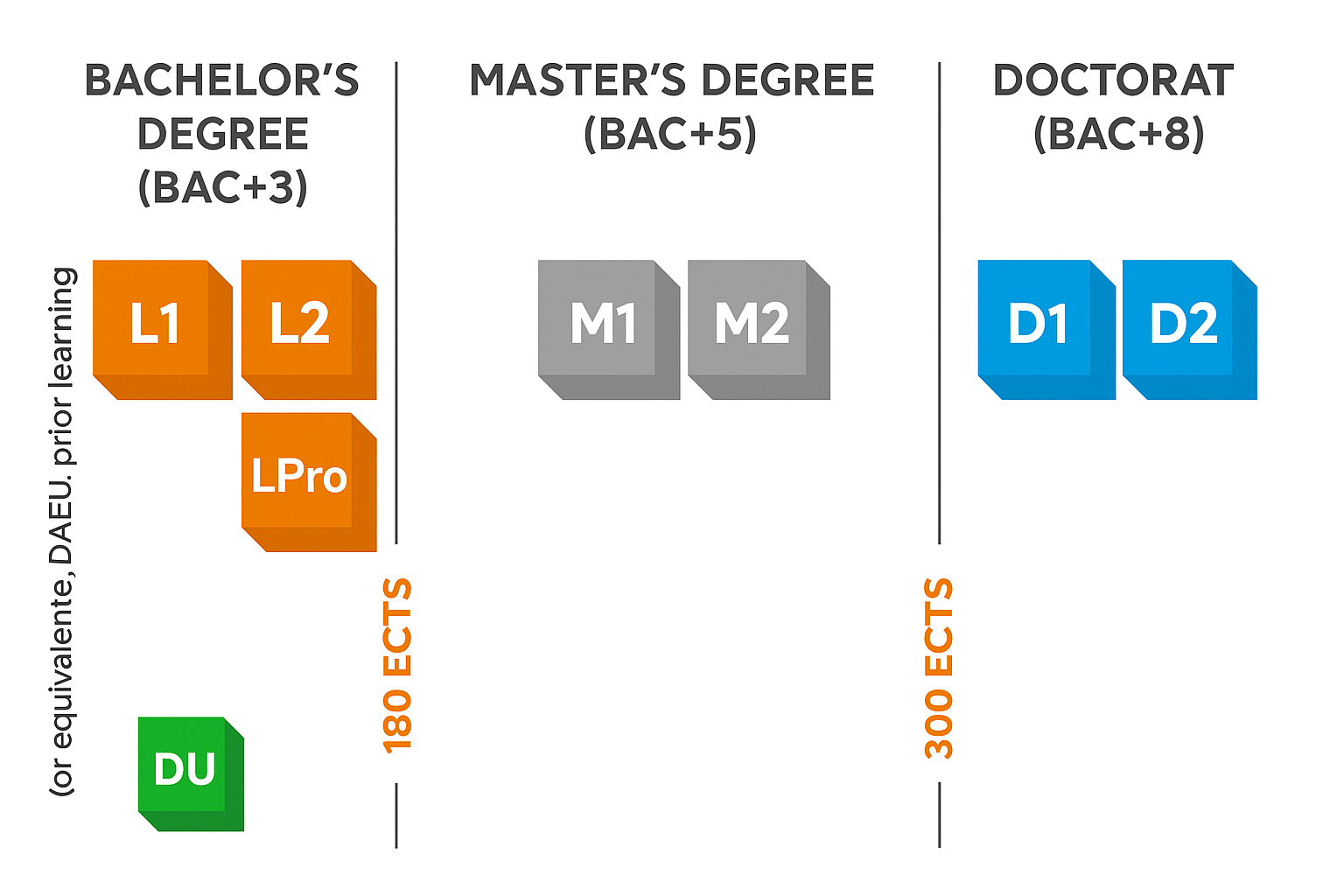
The structure of training in the LMD system is based on 3 degrees: BACHELOR – MASTER – DOCTORATE
Training programs are organized into semesters and teaching units (UE) that are transferable and capitalizable
Implementation of the credit system
The Semester
► The semester is the periodic duration of training units: the basic unit of training is no longer the academic year but the semester.
► The three study cycles are expressed in semesters:
Bachelor: 6 semesters
Master: 4 semesters
Doctorate: 6 semesters
► A semester has a defined number of weeks: 1 semester = 15 weeks (teaching + evaluation)
Semester and Credits
► A semester corresponds to a set workload measured in credits.
► All the UE (teaching units) of a semester total 30 credits.
► Therefore:
1st cycle = Bachelor = 180 credits
2nd cycle = Master = 120 credits
3rd cycle = Doctorate preparation
The Teaching Unit (UE)
► The basic unit of a study program = an autonomous and coherent subdivision within a curriculum.
► Teaching methods:
Lectures, tutorials, practicals, fieldwork, research, etc.
Or a combination of these forms.
► Its value is defined in credits.
► It is coded and numbered.
► Validation and promotion:
Obtain the required average for the UE
Accumulate all required UEs to obtain a degree or diploma
The Credit
► A unit that determines the value of a UE and the total workload (CTT) required to achieve its objectives.
► 1 credit = 20 hours of CTT for the student: lectures, tutorials, practicals, research, internships, and personal work.
► A semester has 30 credits:
Equivalent to 600 hours of student workload
Maximum of 360 hours of classroom teaching per semester (exceptionally 420H)
Classroom teaching = max 30 hours per week (exceptionally 35H)
What is a Study Pathway?
► It is the route chosen by the student to achieve their educational goals.
► The mix of compulsory, optional, and elective UEs allows them to design a personal path.
Distribution of UEs during the study program
Level 1: Purpose = Foundations (UEF): essential basic knowledge
Level 2: Purpose = Deepening (UEM): essential knowledge for the pathway
Level 3: Purpose = Specialization (UED): courses leading to diploma majors
Level 4: Purpose = Complementary (UET): additional to the major or minors